By Dyan Rosenberg
Artist & Jewelry Designer
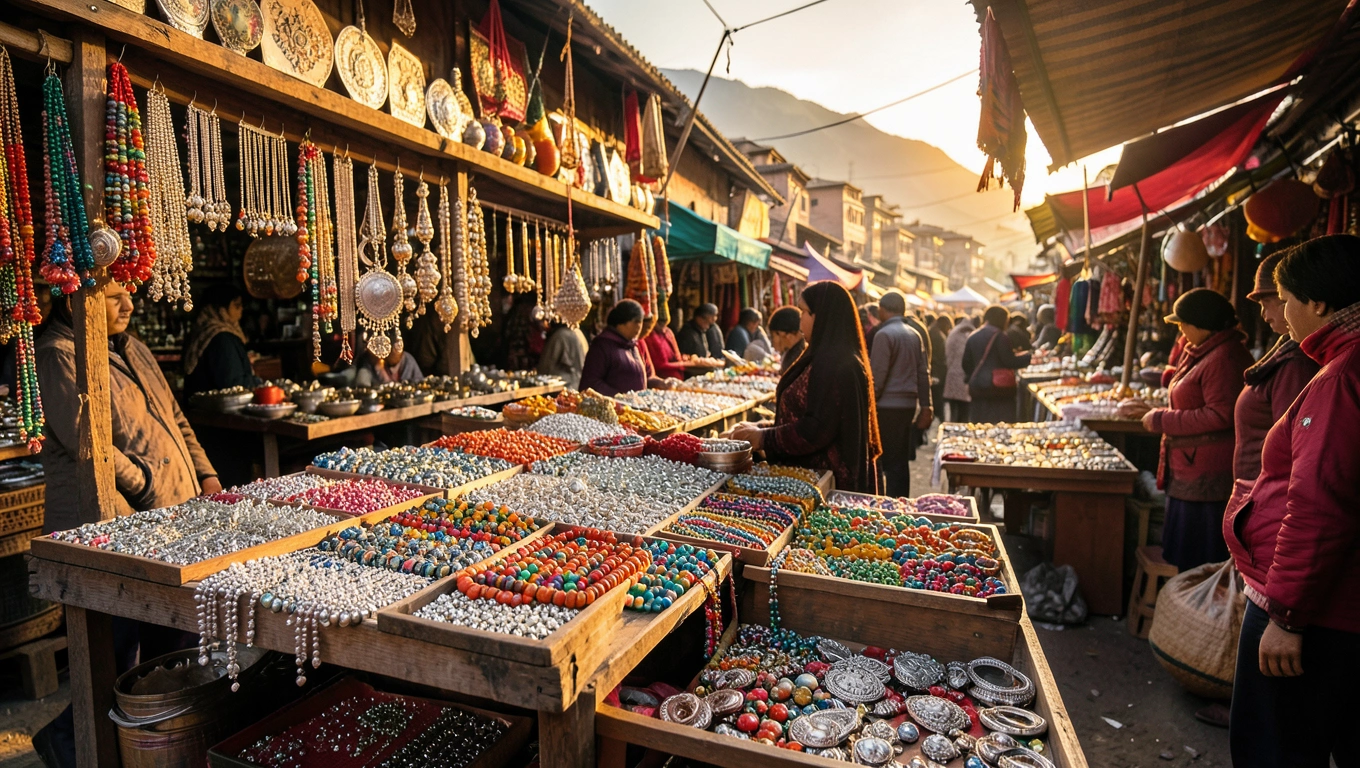
I arrived in Kathmandu just before sunrise. The city was still wrapped in its blue morning silence, but the market was already stirring.
The Asan Tole neighborhood wakes early. By the time light reached the metal rooftops, I was already crouched over a trader's mat covered in silver beads — hand-stamped, oxidized to a rich pewter grey, each one different from the last. These weren't factory-made. These were made by hands that learned the craft from hands before them.
Nepal and northern India are two of the richest sources for antique silver beads in the world. The tradition here stretches back centuries — silver mixed with alloys to strengthen it for everyday wear, stamped with geometric motifs that carry regional meaning, strung and worn as protection, status, beauty, and identity all at once.
What I Look For
When I source silver beads, I'm not looking for uniformity. I'm looking for character. A slight dent where a bead was pressed. A patina that tells you this piece was actually worn, passed down, lived in. Perfectly matched beads are beautiful, but it's the mismatch — the variation in size, the slight differences in stamp depth — that gives a necklace its soul.
I look for three things above all: the weight (real silver feels different in the hand — solid, cool, present), the surface texture (hand-stamped work has slight inconsistencies that machine-work never has), and the patina (aged silver develops a warmth that new silver simply cannot replicate).
"Every antique bead is a conversation with someone I'll never meet — the artisan who made it, the person who wore it, the trader who carried it across borders."
Silver from the Hill Tribes
Some of my most treasured finds come not from the city markets but from the hill villages — beads made by Sherpa communities in the Himalayas, or by artisans from the Newari tradition, which has produced some of Nepal's most refined metalwork for over a thousand years.
Newari silver often features dense repoussé work — the metal hammered from the back to create raised designs on the front. Lotus flowers, protective eyes, geometric borders. I once found a strand of Newari beads at a small shop near the Boudhanath stupa, each bead hand-engraved with a mandala pattern so fine I needed a loupe to see the detail clearly.
From Rajasthan in northern India, I source a different kind of silver: larger, more tribal, with bold geometric stamps and chunky forms. Rajasthani silver was traditionally worn in large quantities — heavy necklaces, stacked bangles, layered earrings. There's nothing subtle about it, and I love that. A single large Rajasthani pendant can anchor an entire necklace.
The Ethics of Old Silver
I'm often asked whether buying antique beads takes heritage away from the communities that made them. It's a fair question, and one I think about constantly. My approach is to buy from established traders who work with communities, to pay fair prices (never bargaining pieces down to nothing), and to treat what I carry back with genuine respect — turning these objects into new pieces that will be worn, loved, and perhaps passed on again.
The alternative — leaving these beads in boxes, unseen — seems a worse fate for objects made to be worn.
In the Collection
Several pieces in the current collection feature Nepalese and Indian silver: the sterling silver ethnic necklace, the gold-silver-vermeil layered piece, and the large pendant necklace that anchors coral and wood beads with an antique Rajasthani centrepiece. Each one carries a geography, a history, and a pair of hands I was lucky enough to meet — or imagine.
See the silver in the collection
Each piece featuring Nepalese and Indian silver is one-of-a-kind.
View the Collection